Sunday, March 1, 2020

Bayan Scholars Engage in Real Talk about anti-Blackness

Bayan recently held a “Real Talk” dialogue to discuss how we individually and collectively circulate anti-Blackness. By “anti-blackness,” we mean beliefs, words, actions, inaction, or policies that perpetuate racism toward African Americans. Anti-Blackness is a relatively new term. It is not meant to replace terms like “racism;” the term distinguishes racism that specifically targets African Americans. 


Twenty students and Southwestern professionals of Filipino descent met in small and large group discussions. We wrestled with questions probing our experiences observing anti-Blackness, how we contribute to anti-Blackness, what stops us from confronting our own anti-Blackness, and what prevents us from speaking out or taking action against anti-Blackness. 

The impetus for the program was three-fold. Part of our motivation came from some of our members' participation in Asian Solidarity Collective of San Diego's Anti-Blackness Convo. Another is the fact that the Bayan Learning Community will soon share a physical space on campus, "The Hub,"  with UMOJA, the African American Learning Community and the PUENTE program, the Latinx Learning Community. An overarching aim of this event is that Bayan is a space where Filipino/a American students prepare themselves not just to know themselves but also to prepare to enter and build a multicultural, multiracial, interethnic world. 

We knew we had to be purposeful in order to play a part to build an anti-racist world. And we recognized that this work requires self-awareness and consciousness of our own particular and collective relationship to anti-Blackness. This is why we needed to speak amongst ourselves and share our stories in order to be better at combating anti-Blackness.
Students mentioned anxiety about participating; many had never addressed the issue until this event. Being among friends made the convo feel less scary. “Anti-Blackness is a touchy subject,” one student wrote in his reflection on the event. “It makes me think about everyone that has been affected by this. . . .[And yet] I knew that I was not going to have much difficulty once I saw my group. I was paired with people that I’m close with, so I was open to sharing.” 

The dialogue structure helped one student be brave: “Having the faculty facilitate the conversation helped me open up about my anti-Black attitude and behaviors because there was someone there to guide the conversation and steer it into a new direction if things were about to get heated.” That environment helped folks tell difficult truths: “What surprised me about the event was that a lot of us [witnessed] some sort of anti-Black racism.” 
Goals and Communication Habits to Encourage Real Talk 

Many realized how anti-Blackness seeped into our lives. One recalled how he was “conditioned” to be anti-Black: “I remember as a young kid, my family would tell me to stay away from black people because they are criminals and a bad influence on others. At the time, I believed my parents. And for a long time, I had mixed feelings and views about Black people.” However, having African American people in his life changed his views, how real connection combats stereotypes: “In middle school, I started to meet and have more Black friends and they were able to change my perspective . . . and allowed me to break out the false messages about Black people.” 

Others mentioned how “colorism” in the Filipino community, the way lighter complexion is valued over dark skin tones, factors into anti-Blackness. Sharing those experiences unveiled how “colonial mentality” reinforces anti-Blackness. “We are sometimes inherently racist at times, and we don't even know it,” wrote another scholar, “especially stories about Filipino parents telling their children to not play outside to not darken their skin.” One student wrote about how internalized racism predisposes us to anti-Black attitudes.”Colonial mentality of ‘white skin equaling beauty’ in the Philippines is negatively affecting darker toned Filipinos and positively reinforcing Western ideals. It is prominent enough that when you travel to the Philippines, skin whitening products are all over the market and on the TV.”

This line of discussion revealed how we don’t spend intentionally talking about internal struggles ;like colonial mentality. One shared a common story: “ When I was younger, I was met with a lot of confusion of whether or not Filipinos were considered Asians or Pacific Islanders.” Someone else noted that, “Self awareness about our own Filipinx identity and experiences [can] help us deal with anti-blackness because it allows us to share our story” helping us to see points of connection and responsibility.
One student’s response summarized what many expressed: “I personally do not engage in addressing anti-Blackness because prior to this event, I did not know about this topic. Now that I am aware, I would engage in a deeper discussion on anti-Blackness with my peers.” She states how she wants to bring the conversation to others in her life: “ I would also talk to my parents about this topic because I have a close enough relationship with them where I can bring up issues such as anti-Blackness and have a conversation with my parents without any of us becoming "offended" by what one of us is saying.” Her final comment points to a possible follow up “Real Talk” - how to specifically address or “call in” someone saying or doing something anti-Black
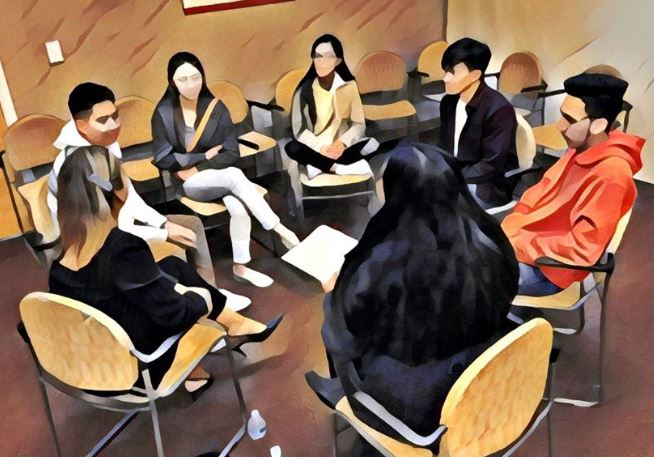
We covered a lot of ground in two hours.Naming our contribution to anti-Blackness is a good first step. Recognizing how anti-Blackness is rooted in home-training and our historical experience with imperialism and colonial mentality is another important step. These revelations point to an analogous histories of marginalization African Americans and Filipinos face in the United States. That “family of resemblance” perhaps provides a point of connection and empathy. 

At the same time, there’s more work to do. Folks recognized we must link awareness and stories with action. One student mentioned the relationship between “looking inward” and taking action: “We gain more knowledge and awareness when we combat stereotypes and stand up for one another. I personally gain a sense of gratitude and more awareness of situations that try to bring races down.” His words remind us that awareness and action build upon one another, helping us be better: “I try my absolute best to stand up for people who are being discriminated against. If someone is getting bullied or is being excluded, I try to help to de-escalate the situation by either talking to them or defending them.”


Big salamat to Bayan Scholars for giving us permission to share their reflections. 

Tuesday, February 25, 2020

Of “Common Sense” & SMART Goals: Practice using Mentor Texts

This semester, Bayan Scholars asked professors to devote formal time to helping them prioritize and set goals - academic and otherwise. To that end, we played with the SMART protocol, an acronym that spells out traits of an effective plan: Specific, Measureable, Actionable, Realistic, and Time Oriented. Instead of relegating this topic solely to the Personal Development class, the professors wove SMART goals activities throughout the program. 

After a range of activities at the Winter retreat and Personal Development classes to develop ideas, students met up with both the Bayan professors to share their preliminary written SMART plan brainstorms. During these individual conferences, Bayan scholars received feedback, and subsequently revised and added in their journals more ideas into their prewriting.  

After all that, students had developed quite a lot of content they could use to create a statement, a narrative of their goals. In the English class, writers began to shape that content into a formal essay. 

To do so, students analyzed three “founding documents” of the United States: "The Declaration of Independence," The Preamble to the Constitution, and an excerpt of Thomas Paine’s pamphlet “Common Sense.” Our purpose was less about the content than about the “moves” the authors used to express their ideas, the decisions they made around structuring their content - the "bite" the authors' patterns of expression. 

For instance, the Preamble is basically made up of three “chunks,” three distinct moves that answer the questions:
  • Who are we? 
  • What’s our collective problem? 
  • What do we propose to do? 

Wednesday, February 5, 2020

Snowballs and Transitions to Higher Education

The academic core of the Bayan Community is a pair of linked classes: English Composition and Personal Development. Most of us have a good idea about English classes. We write. We read. We write and read - a lot, practicing the analytical and critical skills students need to succeed in college and beyond. But what about Personal Development? What is "PD"? What do students do in a PD  class? 

This semester’s Personal Development class is PD 114, “Transitions in Higher Education,” a course that provides a step-by-step approach to preparing for the culture and rules of higher education as well as acquiring and practicing the “soft-skills” required to the move from community college setting to a four year institution. This also include in the process of selecting and applying for college and securing funds to pay for it all. 

The very first activity of the semester students did is emblematic of the work students do in PD. Professor Crystal Alberto, Bayan’s coordinator and counselor, canvassed from students the obstacles, barriers, and issues they anticipate facing when they get to the college of their choice. She used one of the students’ favorite routines, the “snowball fight,” to brainstorm different items. Students jot down answers to a series of questions onto a sheet of scratch paper, crumple up those sheets, and toss them in the air to simulate a snowball fight. Students pick up the "snowballs", unwrap them, and share written responses with the entire class. A discussion follows to debrief and unpack ideas. Here's a link to guidelines for the activity. 

Because of the Filipino focus in the Bayan Learning Community, Professor Alberto used questions that compelled students to look for a "Filipino" angle regarding transferring. To be sure, many of the items on the list Bayan Scholars generated apply to all transfer students. And still, noting the particular "flavor" of their obstacles helped students see that their cultural and ethnic identities are constitutive, at least part, of what they may experience. That identity piece is definitely a worthy angle of investigation. 

Tuesday, February 4, 2020

Agbayani Village Trip: Pride and Provocation


Once again, Bayan Scholars made our way to Agbayani Village in Delano; it's become a yearly tradition for our learning community. This year, we visited this historic site on November 7th and 8th, a few weeks after Filipino American History month. To prepare for the trip, we devoted class time to begin untangling the difference between history and heritage. We also studied sections from Dawn Mabalon's Little Manila is in the Heart to familiarize ourselves with the plight of Filipino farm workers and the significance of Delano.

Saturday, December 14, 2019

SWC Professionals help Bayan Scholars Develop Networking Skills

Photo by Ernesto Rivera
As we grow, Bayan plans to offer a mentor program, matching scholars with professionals for all the benefits we know that mentorship provides. Even as we aren’t at a place - yet! - for a full-blown mentor program as  PUENTE has, we can still help students develop skills they will need to make the most of mentor opportunities such as networking, introducing ourselves, asking questions - those “soft skills” that can make a huge difference. 

To that end, we set up a “mixer event” where students and Southwestern College professionals met “cocktail party-style” (there was no alcohol - just candy!) to practice meeting and greeting each other.

We broke the program up over a few days, reserving a portion of two class periods of Personal Development to prepare for the event. On the first day, students composed and practiced informal “elevator pitches,” quick self-introductions students might make when meeting a new teacher, prospective employer, or other person who they meet. The pitches we practiced were less formal than those proposed by Forbes or LinkedIn. Ours were intended for a more casual, low stakes situation. Folks jotted down their elevator pitches and practiced in front of the class and in pairs. 

Wednesday, December 11, 2019

Prepping for Finals: Finishing Strong!


At our last class meeting, the week before finals, we asked ourselves what we needed in order to finish the semester strong (yes, it should be "strongly", but artistic license, yeah?). For all but one student, this is first semester in college for everyone, our first experience with the ups and downs of the season, so we needed to spend a few minutes attending to this pressing issue. 

Scholars wrote their advice on index cards, and we collect them here in the two-minute video embedded above. In the spirit of helping ourselves, each other, and our followers, we share our collective advice for thriving during this crazy-making time of year.

What advice do you have for finishing out a session of school? What works for you? Share your comments below. Oh, and here's a link to the video should you want to share it. Cheers! 

Saturday, December 7, 2019

Being Sweet: Caring for the Brains in our Bodies

In our quest to be more holistic in our approach in Bayan, we asked students to consider the concept of “sweet”. Not “sweet” as in sugar or candy, what FIlipinos would call mamatis. This "sweet" is an acronym to help us remember what we need to do to take care of the brains are in our body, to make sure that we attend to, crudely put, the physiology of learning. 

Sweet stands for Sleep, Water, Eating Healthy, Exercise, and Time to Relax, practices required to take care of our bodies, which in turn, keeps our brains working at top conditions for the cognitive challenges we face in our classes. 

With the exception of time, the elements of being sweet are easy to grasp. Time, in sweet terms, has to do with giving our brains and bodies “down time”, perhaps meditating or purposeful relaxation. Not channel surfing or binging on Netflix, but intentional practices to allow our bodies and brains to rest. Like the kind of "diffuse thinking" that Barbara Oakley discusses in her book Learning How to Learn

Jose Bowen, president of Goucher College and author of the provocatively titled  Teaching Naked discussed the “sweet” acronym on an episode of Teaching in Higher Education. We introduced sweet the first day of class. Every so often, we'd revisit the concept to check ourselves. Below is a Flipgrid, a video recording, of students' sweet self-evaluation we did right before the Thanksgiving long weekend because after the weekend, we only have one more week before finals. We figured that just before a break it would a good time to review how well we are treating the brains in our body. Have a look, and leave a comment about your sweet status below! 

Sunday, December 1, 2019

Bayan Scholars Reflect on History & Heritage

October is Filipino American History Month, a commemoration instituted in 1991 by the Filipino American National Historical Society (FANHS) to preserve, disseminate, and celebrate the history of Filipinos and Filipinas in the United States. To mark the event, we spent time in our English class considering what we know about our experiences in the USA. 

To get started, we used our writer’s notebook to generate and organize our ideas. The following questions focused our thinking:

  • What do you think you know about Filipina/Filipino American history? How did you acquire that knowledge? 
  • What's the difference between "history" and "heritage"?

Saturday, November 23, 2019

Pop Up Claims - Developing Ideas Worth Writing About

This post features Bayan's experiment with an activity cribbed from Dave Stuart, Jr.’s Let’s Make Teaching Better called “pop up debates”. Stuart’s process calls for single arguable point, but we focused instead on coming up with claims and verbally reporting those opinions with the rest of the class. We wanted to build confidence to come up with and publicly share opinions worth knowing.


This semester, we are studying Kevin Nadal’s book Filipino American Psychology. Together, we read the first two chapters. Chapter One provides a super brief sketch of Filipinas and Filipinos in the United States, demographics, how we got to the US, and the psychological impact of our history and place in US society. The second chapter focuses on Filipino values. As very few Bayan students had any formal coursework on Filipina/o American issues, we needed shared pool of knowledge these chapters offered.


After working through those chapters, we briefly examined the themes of the other chapters. Topics ranged from Racial and Ethnic Identity Development to Gender/Sexuality/Sexual Orientation, from the Model Minority Myth to Colonial Mentality. Subsequently everyone selected two to read beyond the ones we had studied together. We read these new chapters with the aim of teaching what we discovered with each other.

Saturday, December 15, 2018

Agbayani Village + CSU Bakersfield Trip


December 7th and 8th, Bayan Scholars Learning Community took a Cultural Immersion and Transfer University Exposure tour. The trip provided cultural insight and increased awareness and transfer possibilities outside of our local universities.

Sunday, December 2, 2018

Improving Class Discussions/Cultivating our Bayan

Early November, we attempted our second Socratic Seminar in our English class. One goal was to increase our capacity to effectively use Socratic Seminars; we are experimenting and learning as we go. After the seminar, we used Flipgrid to collect our feedback about how to improve class discussions in general and how to make or Socratic Seminars more powerful. Listen to our feedback below.

The specific aim of this Socratic Seminar was to discuss how to improve the Bayan Learning Community. As a jumping off point, we used our experiences this semester, the documentary Precious Knowledge (see the post "Exploring Precious Knowledge"). We also used selected passages from the journal article "Dangerous Minds in Tucson" by Professor Curtis Acosta, one of the teachers featured in Precious Knowledge.


We had a long and often heated discussion about how to  improve Bayan,  and we came up with several tentative ideas. For instance, there’s talk about adding a third course to the cohort (currently, scholars take a Personal Development and English class), including more history topics, and having more opportunities for meaningful socializing.

Click on the images of Bayan Scholars hear their suggestions about improving discussions and building our program. If you have any ideas about Socratic Seminars or ideas about improving Bayan, we’d love to hear from you; comment below!


- Salamat to Jonny H. for his able assistance authoring this blog.

Tuesday, November 27, 2018

Identity & History: Reflecting on Fil Am History Month

October is Filipinx American HIstory month. Bayan Scholars investigated various historical topics, themes they had rarely explored, if at all,  prior to joining the Bayan Learning Community. 

This blog entry is the second installment of student responses to Pilipinx American History Month activities at Southwestern college as well as coursework in our Bayan classes. These responses tended to be more about internal, psychological issues as opposed to the more historically inflected responses from the first installment, Reclaiming History

These particular responses demonstrate the complicated relationship between history and psychology. They begin to uncover the nuanced and often hidden ways material history can condition one's sense of self. While Bayan scholars (students and faculty alike!) recognize that identity is not reducible to history and material conditions, we are beginning to appreciate the complex connection between the past and personality.

Moreover, you can see from several posts that these scholars are making connections between their personal lives and the curriculum. They use their academic identity to explore their personal identity, which is in line with the project of humanizing their education (see see entries "Summer Retreat Part I, Part II and Part III for background on how "rehumanizing our education" fits into Bayan's project). 

To collect student reflections, we used the online bulletin board application Padlet. To magnify an entry, float your cursor over the upper right-hand corner of a particular post and click on "expand post".  We welcome your comments! 

Monday, November 26, 2018

Bayan Version of "When Did You Realize Your Race?"

Bayan is an Filipino based community where we focus on  Filipinx American experiences, even though not everybody in our program is Filipinx. Both our English and Personal Development classes help us focus on our identities. In October, we did an exercise to share milestones about our racial or cultural identities. We tried to answer a range of questions about "who we are": When did we  become conscious of our racial or cultural identities? What happened? When did this occur? What did we think and feel? What lessons did we learn? 

These discussions are important because it give us each a chance to investigate our personal stories and to notice if we share common experiences,i.e., to see what makes us unique and what binds us together. Sharing also helps with a sense of belonging, perhaps reducing feelings of socially isolation. We can learn from each others’ stories, even as we begin to appreciate that no one story is representative of an entire people. 

Just as important, we wanted to work against the idea that talking about race is “taboo”. We cannot solve problems associated with racial or cultural identity unless we engage in reflection and dialogue. While we are only beginning our exploration, we'd like to share our initial steps with you. 

We used Flipgrid to record our responses.We based this project on a video featured on an episode of MTV's Decoded by Francesca Ramsey called "When Did You Realize Your Race?" To screen an individual story, click on the scholar's image below. Click on the "Decoded" image to screen  Francesca Ramsey's video. 

We welcome any feedback or comments. Perhaps you might share your story with us, too!


- Many thanks to Jessica B. for her assist with this blog post. 


Saturday, November 24, 2018

Celebrating Pilipinx American History Month at Miracosta College

To celebrate Pilipinx American History Month (PAHM), Miracosta College hosted the Building PAHMilya conference. The event included speakers, workshops, and activities meant to recognize and promote Pilipinx history and culture. Conference organizers chose the word “Pilipinx” as a gender inclusive term. A team of Southwestern Bayan Scholars attended the program and had lots to say about the day’s event. This blog entry documents some of those reactions.


Riane R.’s reflection captured the experiences of attendees: “The PAHMilya conference up in Miracosta College was honestly the best thing I've been to! It taught me a whole lot on the history of being a Pilipinx American and how this month of October is dedicated to that. The people were fun to be around, the workshops were very interesting to go to, and the whole thing was just an awesome experience to witness.”


Jared C. pointed out the  importance of hearing other Pilipinx students share their experiences: “Hearing experiences of other students made me feel so much more connected on a personal level with other students that are of the same ethnicity as I am. I never knew that feeling alone racially was an important issue that needed to be talked about. I now wish to continue dialogue between students because these relatable discussions really bring us together as a people.”


One of the most significant moments in the day’s program was the keynote by Cristine
Sidela, the coordinator of Academic Successes and Equity Programs. JP A. noted the impact of Sidela’s keynote: “It was inspirational. Especially when she spoke about her experiences to get to where she is today. This hit me hard because I am walking my path to my goal. Attending the event made me see how there are other Filipinx out there that want to start a community to help Filipino Americans. This is important because of the prejudice of being Filipino even though you're American born, or those who do not feel Filipino enough have a place to be welcomed.

Sunday, November 18, 2018

Reclaiming History: Filipino American History Month

October is Filipino American History Month, established in on 1987 by the Filipino American National Historical Society (FANHS). To commemorate this month, Bayan Scholars attended a film screening of Marissa Aroy’s documentary Delano Manongs that features the often hidden history of FIlipino farm workers and their contribution to the Farm Workers movement. 

Local high school counselor Reynilla Calderon-Magbuhat presented her history workshop “Know History, Know Self”. Both events were co-sponsored by Southwestern College's Filipino Student Organization Pagkakaisa, Bayan Student Organization, and Southwestern College’s Office of Student Equity Programs and Services

We also read several chapters from Filipino American Psychology, a text book by Professor Kevin Nadal. We paid special attention to those sections pertaining to cultural values and to how history can condition identity. 

For practically every scholar in Bayan, this month was they spent so much time in an academic setting focused on Filipino experiences. Indeed, it was most Bayan Scholars’ initial exposure to Filipino American history and culture as topic worthy scholarly attention.

This blog collects a sampling of several Bayan scholars’ reflections below, their first time considering Filipino American history. These young adults are only now being introduced to the legacy and heritage of Filipinos in American. We invite you to read these entries with that in mind. And we welcome your comment below should you wish.


To enlarge individual entries, hover your cursor over the upper right hand corner of the post. Then click on “enlarge”.

Saturday, November 17, 2018

Exploring Precious Knowledge

Early November, we watched the film  Precious Knowledge, an educational documentary filmed in 2011 by Dos Vatos Productions. The documentary focuses on the ban of the Mexican-American Studies (MAS) Program in Tucson, Arizona. This film includes stories of the students who were a part of MAS. Filmmakers spent an entire year in the classroom and community filming this innovative social-justice curriculum, documenting the transformative impact on students who become engaged, informed, and active in their school and communities.


Precious Knowledge gives viewers an inside look in the classroom of two Raza studies program teachers, Curtis Acosta who teaches literature, and Jose Gonzalez who teaches American Government. Acosta and Gonzalez taught students about their history and culture, and challenging them to reflect, realize and reconcile with their status in US society.

Six Weeks In: Using Writing to Reflect on our Development

Time is less and less our friend this semester! Finals are fast approaching, and we’ve yet to post a single entry. Our intention for Sariling Atin blog page was to keep our friends “in-the-loop” as to what we are learning and experiencing in our Bayan Learning Community. 

To be sure, we’ve been writing, reading, reflecting - a lot! And many of the assignments were tailored toward composing digestible bits and bites of our experiences to share with our readers. But we haven't kept up with our commitment to publicize our journey. 


This post shares Bayan Scholars thoughts and feelings about joining our learning community and their reflections about their first semester in college (all but one or two scholars are entering, first-year freshman). During the sixth week of class, we used Padlet to record our reflections. If you want to enlarge a particular scholar’s post, float your cursor toward the top right-hand corner of post and select “expand”. 

The purpose of this "Padlet project" was to engage in “metacognition”, to reflect on our thinking and our experiences. We used writing to develop introspection skills to support learning and personal development. A second aim was to make public the variety and range of experiences scholars encounter in an ethnic/culturally-focused learning community. 

We have at least eight posts in the pipeline. Stay tuned! We welcome comments! 

Saturday, October 6, 2018

Summer Retreat, Part III: So, What’s Next?

Bayan Student Organization Board Members
Note: This entry is the third of three posts that record the ideas Bayan scholars and professors had at at our Summer 2018 planning retreat,The first entry outlines our reflections about what made our experiences feel humanized, what made the learning feel so “live”. The second entry outlines our exploration about the particularity of Filipino American experience that requires a special kind of “rehumanization”. We began exploring what about the our own individual experiences, sociology, and history might account for the dehumanization. This third and final entry outlines suggestions and ideas 

For the final portion of the retreat, we discussed suggestions for next year.We came up with four themes, all of which logically followed from the retreat activities and our experiences in Bayan. 

Focus on History/Sociology and Identity : A significant portion of the discussion focused around our lack of formal knowledge regarding Filipino American history and sociology. How did we get here? What, if anything, characterized our peoples’ experiences. What were the factors that lead to our inclusion in the US story? How might lack of information or misinformation impact our individual sense of self as well our sense of belonging to the larger society? The professors need to include more history - the stuff students (and professors!) don’t know or information has been hidden. As a class, we can deconstruct and revise our understandings of ourselves and our situation here in the USA. 

Wednesday, August 8, 2018

Summer Retreat, Part II: What's Decolonization got to do with it?

Note: This post is part two of a three-part series about a mini-retreat we held to discuss the principles of and plans for the Bayan Learning Community. See here for the first entry. Third entry is forthcoming!


During the first part of our Summer 2018  mini-retreat, we agreed on a few preliminary understandings of what it means to have a “dehumanized” class (see link). We took it as axiomatic that Bayan folks want (and deserve!) a rehumanized learning environment. The purpose of this section was to establish, or at least  identify, what about Pinoy/Pinay experience and education is dehumanizing.
We had a brief mini-lecture to review how two other racial/cultural groups experience dehumanization and objectification in the United States. We recalled the objectification that African Americans faced included slavery, slave codes, lynching,  and Jim Crow. Those issues morphed into issues that animate the Black Lives Matter movement. This ongoing legacy of dehumanization is what programs like UMOJA seek to remedy.

Tuesday, August 7, 2018

Summer Retreat, Part I: Live Learning

A small but mighty group of nine Southwestern College students and three faculty members  met today for a “mini-retreat” to support the ongoing development of Southwestern College's Bayan, the Filipino/a American learning community. This learning community consists of linked English and Personal Development courses that meet for a period of one year. We’ve been in existence for several years, with a fairly general vision: to support Filipina/o American students transfer to a four year institution. We modeled ourselves after Puente and Umoja, two statewide bodies, devoted to increasing retention and transfer rates of Latinx and African American students respectively. Bayan, like Puente and Umoja,  is open to students of all races and culture.


This blog post is the first of three (3) entries that record what happened at our retreat. After reading each entry we hope get feedback from Bayan and friends of the program to help us strengthen our program.

The purpose of our mini-retreat was to begin a deeper conversation about Bayan principles and values. While we have worked under some general guidelines (instituted by faculty), we believe it’s time to be a bit more deliberate and intentional about our purpose - and to figure out the principles that distinguishes us from the other campus programs and from the other multicultural learning communities. Just as important, we wanted to extend this discussion to include student voices.